 Valmistamme ja toimitamme 24 tunnissa
 Yksinomainen myynti ammattikumppaneille
 Hintamme ovat niin alhaiset, koska myymme 100% verkossa















How a Single-Sided Fly Banner Is Produced
In this article, we break down the production of a standard-size teardrop Fly Banner. Also known as an advertising flag or beach flag, this product is essential in the printing industry. Its lightness, visual impact, and versatility have made it a best-seller for events and promotions.
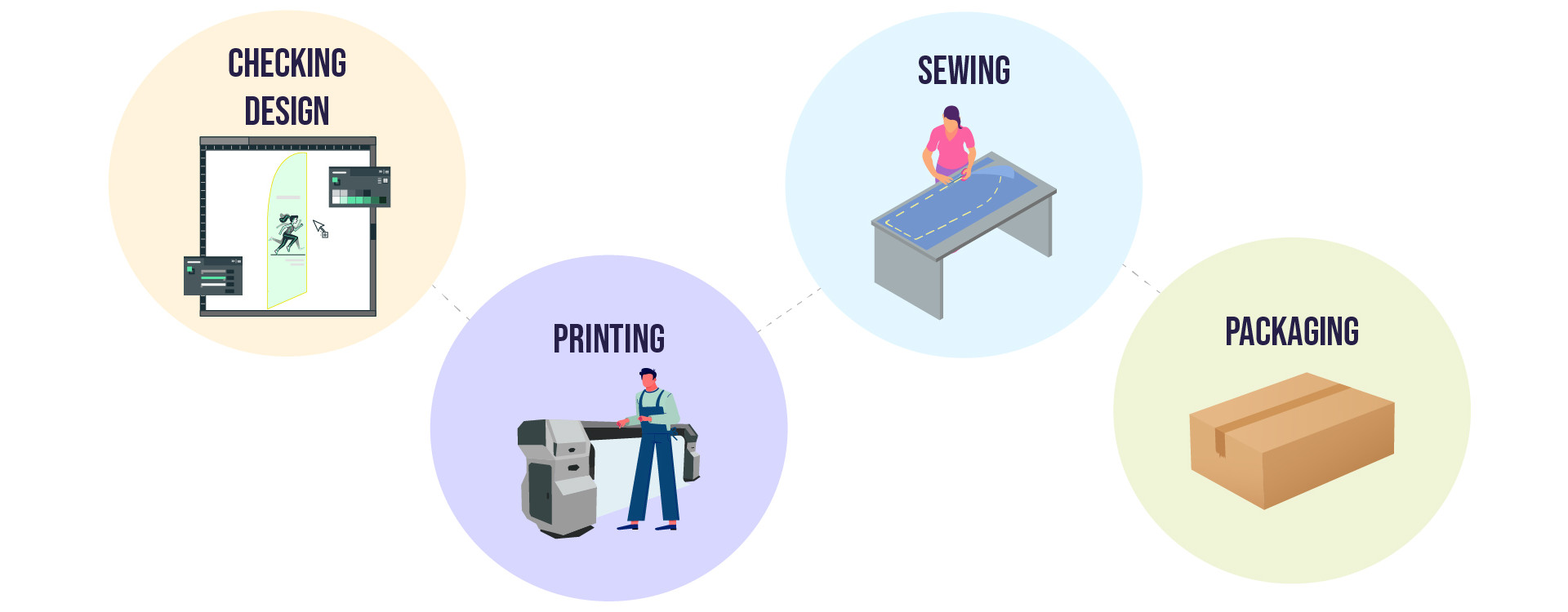
But have you ever wondered what happens behind the scenes? Here, we walk you through the step-by-step process of producing a single-sided Fly Banner — from design validation to final delivery.
Design Review
The production process begins with the order intake and a thorough review of the design by the printing team.
Distributors provide their artwork using the corresponding template, usually in formats such as PDF or Adobe Illustrator. This professional approach ensures the designs are accurate and adapted to the exact dimensions of the Fly Banner, preventing layout or proportion issues.
Our operators check the attached design to ensure it meets the minimum print requirements, including font usage, color modes, and correct adaptation of the artwork to the chosen model’s template.
Sublimation Printing
The next step is fabric printing through sublimation, a technique that guarantees vivid, sharp, and long-lasting colors.
First, the design is printed onto transfer paper using high-definition sublimation inks. The paper is then placed over the fabric, and both materials go through a thermal rotary press at temperatures above 200 °C. During this process, the ink turns into gas and permanently bonds with the fibers of the fabric, resulting in a flawless finish that is resistant to tearing, sun exposure, and adverse weather.
Cutting and Sewing
Once the fabric is printed, it proceeds to the cutting stage. This is done manually using precision tools to ensure a uniform and clean finish.
The pieces then move to the sewing area. Here, operators assemble the Fly Banner using sewing machines designed for polyester and special high‑resistance threads. Additional reinforcements are added to strategic areas to increase durability.
Fly Banner Packaging
Once the Fly Banner is fully assembled, the packaging stage begins. This process includes the following steps:
• Folding and protection: Each banner is carefully folded and placed in a transparent protective plastic bag to prevent damage during transport.
• Component grouping: Poles, bases, and any required accessories are organized together with the banner to ensure packaging efficiency.
• Packaging material selection: Cardboard boxes are chosen according to the size and quantity of items included in the order.
• Labeling and shipping: After grouping everything and selecting the packaging materials, a neutral shipping label is added and the box is handed over to the carrier.
Thanks to our optimized logistics, orders are shipped within 24 hours within Spain and in 1–2 days to other European countries, ensuring fast and reliable delivery.
The Best Part: Assembling the Fly Banner Is Very Easy
Not sure how to assemble your Fly Banner? It’s very simple.
In this video, we show you exactly how to do it.
Conclusion: Start Selling Our Best‑Seller
Now that you know how a Fly Banner is produced, it’s easy to understand why it’s one of the most in‑demand products among distributors and advertising professionals. Its quality, fast production, and quick delivery — combined with competitive prices — make it an essential item for capturing your audience’s attention.
Add this best‑seller to your catalog and start generating more revenue today!
Related posts
 5 practical ways to offer advertising gazebos to your clients
 Fly Banner: Point-of-Sale Advertising for High Street Businesses
 How Are Our Flags Manufactured?